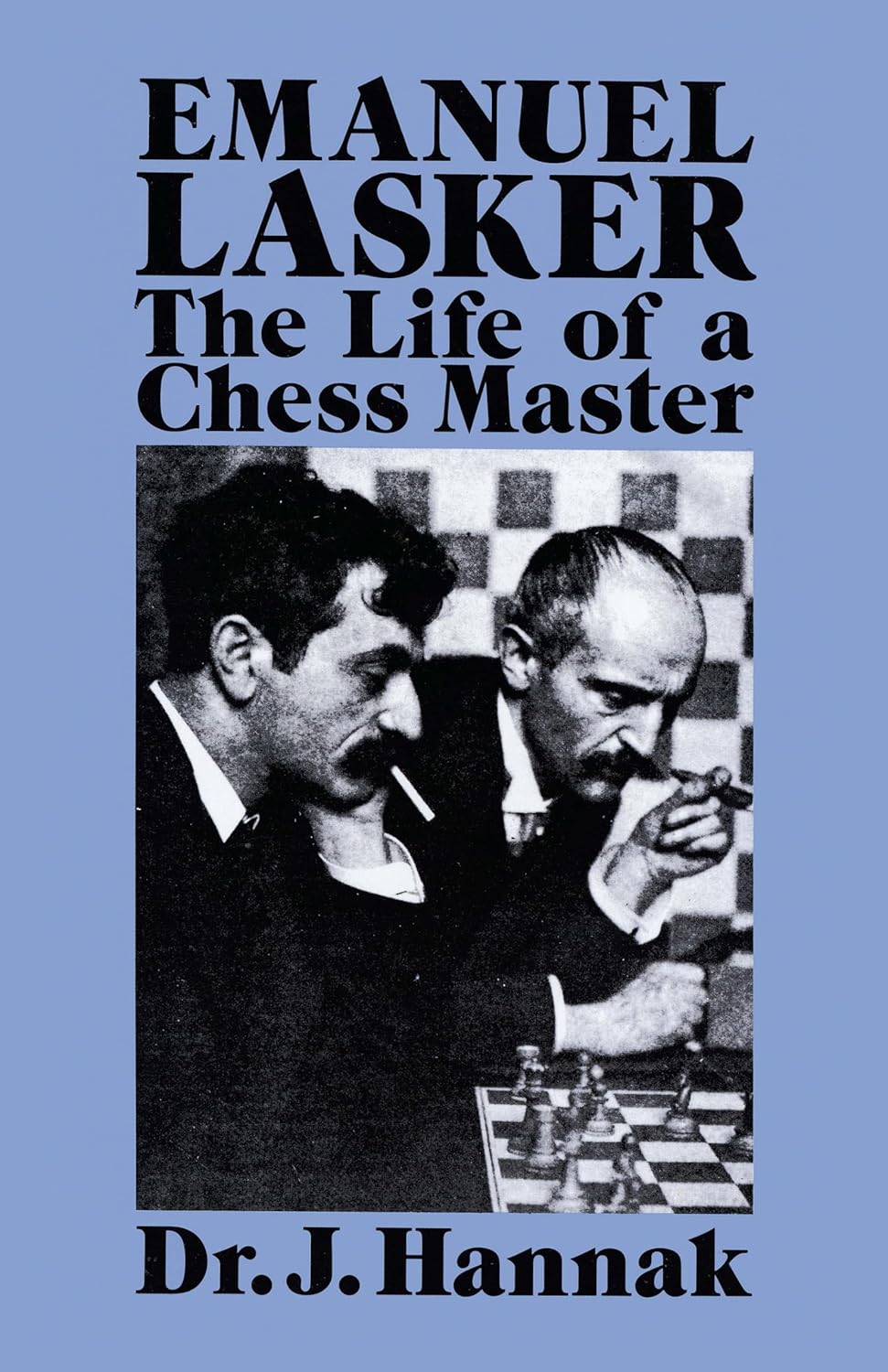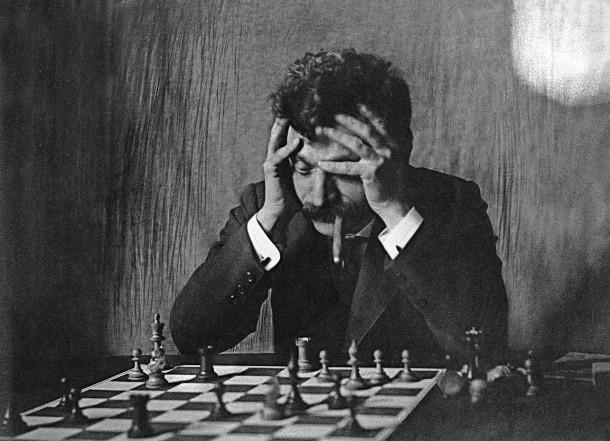
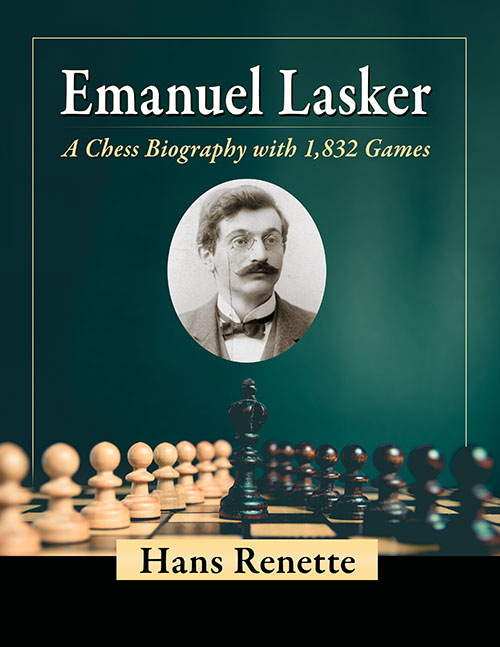
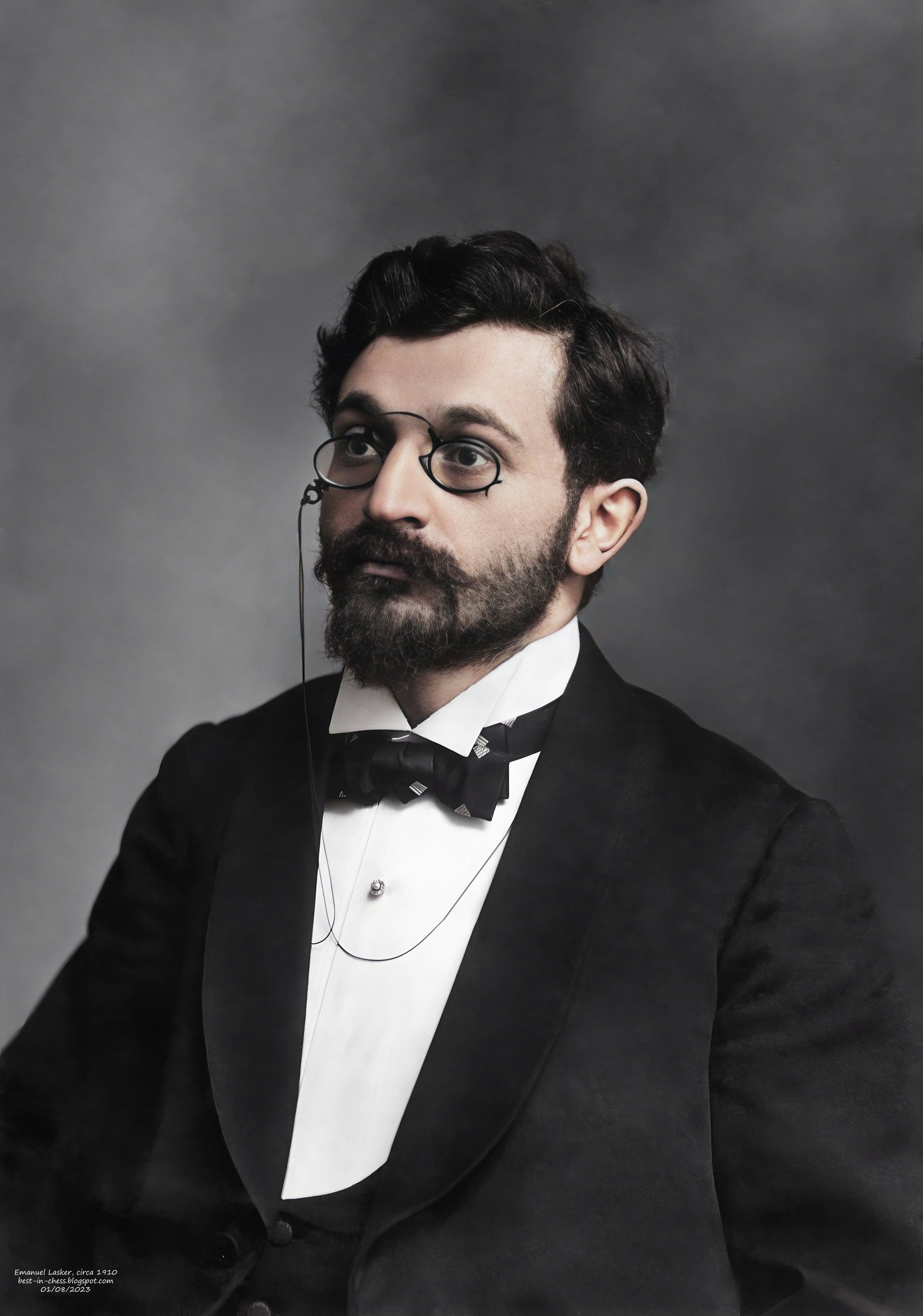
In the smoky cafés of late 19th-century Berlin, where students debated philosophy over cheap coffee and the clatter of chess pieces echoed late into the night, a young Jewish mathematician from a small Prussian town quietly plotted his conquest of the chess world. Emanuel Lasker, born on December 24, 1868, in Berlinchen (now Barlinek, Poland), would hold the World Chess Championship longer than any player in history—27 unbroken years from 1894 to 1921. He wasn’t just a brilliant calculator or a swashbuckling attacker like the romantics before him. Lasker was a fighter, a psychologist, and a universal player who thrived in messy, complicated positions. He deliberately invited complications, outmaneuvered opponents in the fog of battle, and then struck with ruthless precision. His games often looked “wrong” at first glance—provocative moves that defied classical principles—yet they exposed the human flaws in even the strongest rivals. Beyond chess, he earned a doctorate in mathematics (contributing to commutative algebra), wrote philosophy books on struggle and life, excelled at bridge and Go, and invented his own game, Lasca. His life spanned five decades of top-level play, from the gaslit era of Steinitz to the dawn of the modern age, surviving wars, exile, and personal loss with the tenacity that defined his board play.
Lasker’s early world was modest and rooted in Jewish tradition. His father was a cantor in the local synagogue, and his grandfather a rabbi. At age eleven, young Emanuel was sent to Berlin to live with his older brother Berthold, a medical student eight years his senior. Berthold introduced him to chess, and the game quickly became a passion that rivaled his studies in mathematics and philosophy at the universities of Berlin, Göttingen, and Heidelberg. By the late 1880s, Lasker was already playing for money in Berlin’s cafés. In 1889, at just twenty, he burst onto the international scene at the Amsterdam tournament, finishing second. That same year, he produced one of his most famous early brilliancies against Johann Bauer in a game that showcased his tactical flair and willingness to sacrifice for the initiative.
The 1890s marked his rapid ascent. He won the British Chess Association tournament in London in 1892 and swept the New York tournament in 1893 with a perfect 13/13 score—one of the most dominant performances in chess history at the time. Critics began whispering that this young German might be ready to challenge the aging first World Champion, Wilhelm Steinitz. Lasker, confident and ambitious, issued the challenge. The chess world was skeptical. Steinitz was the founder of the modern positional school, while Lasker was seen as an upstart with unorthodox ideas. The 1894 match, played in New York, Philadelphia, and Montreal, proved them wrong. Lasker won convincingly with 10 wins, 5 losses, and 4 draws. At only 25 years old, he became the second official World Champion on May 26, 1894. The victory wasn’t just about calculation; it was about understanding the human element. Lasker later explained that chess was a struggle between two wills, and he excelled at creating positions where his opponents’ psychological weaknesses surfaced.
To silence doubters, Lasker defended his title in a 1896-97 rematch against Steinitz in Moscow. This time the score was even more lopsided: 10 wins, 2 losses, and 5 draws. Steinitz, now in his sixties and struggling with health issues, could not withstand Lasker’s fighting spirit. These two matches established Lasker’s dominance and set the tone for his long reign—he would defend the title successfully five more times against the era’s strongest challengers.
Between title matches, Lasker dominated tournaments. He won Nuremberg 1896, London 1899 (with a massive 21.5/26 score), and Paris 1900. At Hastings 1895, he finished third behind Pillsbury and Chigorin but ahead of Steinitz and Tarrasch. In St. Petersburg 1895-96 and 1914, he triumphed in elite quadrangular and multi-player events. His tournament record from the 1890s to the 1910s was extraordinary: he rarely finished outside the top three, and often won outright even when he entered after long breaks for academic pursuits.
In 1902, Lasker earned his doctorate in mathematics from the University of Erlangen-Nürnberg. His dissertation contributed to the theory of ideals in polynomial rings, work later connected to the Lasker–Noether theorem in commutative algebra. He balanced this intellectual life with chess, publishing Lasker’s Chess Magazine from 1904 to 1907, where he shared deep insights into the game as both science and art. He also wrote philosophical works, most notably Kampf (Struggle, 1907) and later Das Begreifen der Welt (The Comprehension of the World), viewing life itself as a constant battle—mirroring his chess philosophy of embracing complications to outfight opponents.
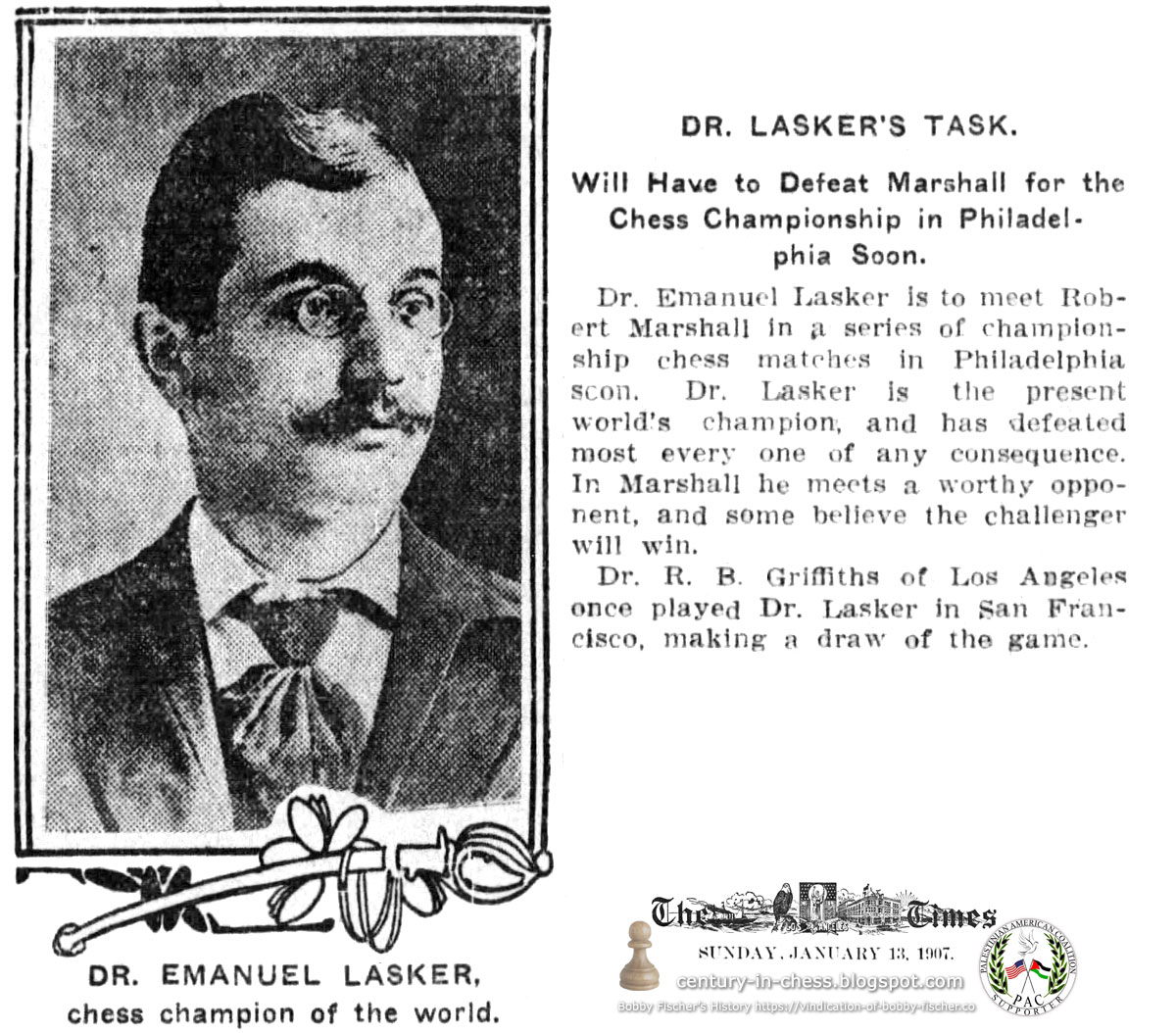
Lasker’s title defenses in the 1900s and 1910s were masterclasses in versatility. In 1907, he crushed American champion Frank Marshall in a match across multiple U.S. cities: 8 wins, 0 losses (with draws not counting toward the win total in some scoring), and 7 draws in the decisive games—essentially a whitewash. Marshall, a brilliant attacker, simply could not break Lasker’s defensive resilience and counterpunching ability. The following year, 1908, came a highly anticipated clash with Siegbert Tarrasch, the “Praeceptor Germaniae” who represented classical, logical chess. Tarrasch had long criticized Lasker’s “unscientific” style. The match in Düsseldorf and Munich ended 10.5–5.5 in Lasker’s favor (8 wins, 3 losses, 5 draws). Lasker’s psychological edge shone through; he thrived in the tense, imbalanced positions that frustrated Tarrasch’s rigid principles.
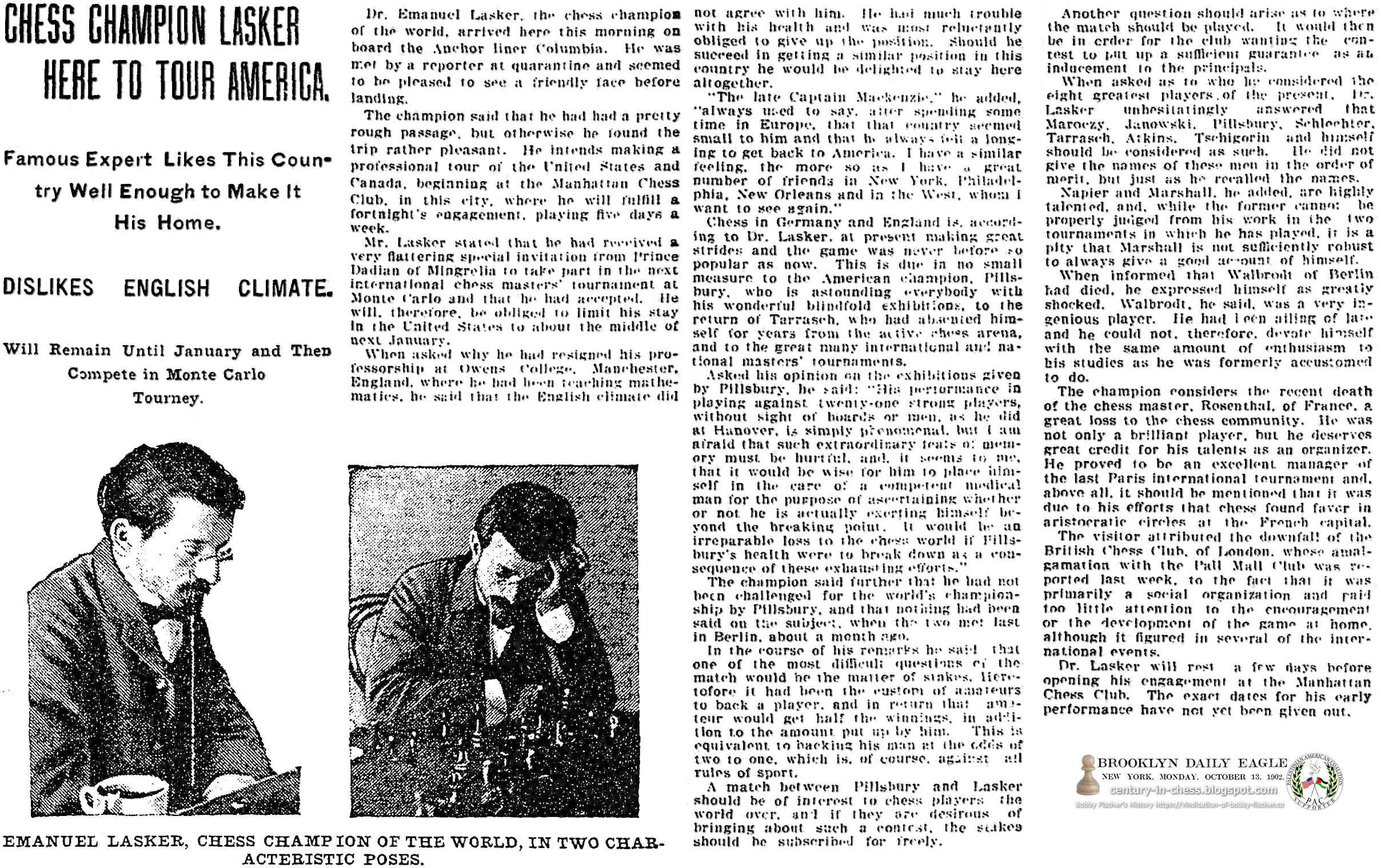
In 1910, Lasker faced two challengers. First, the Austrian Carl Schlechter in a match that ended in a narrow draw (one win each, eight draws). Many historians consider this a successful defense, as the conditions required the challenger to win by a margin. Later that year, Lasker defeated David Janowski decisively. His record in world championship games during his reign was staggering: across six matches, he scored overwhelmingly positive results while rarely losing momentum.
One of Lasker’s most famous tournament triumphs came at St. Petersburg 1914. In a super-tournament featuring Capablanca, Alekhine, Tarrasch, and others, Lasker trailed the young Cuban sensation José Raúl Capablanca by a point and a half entering the final round-robin. In their individual game, Lasker produced a masterpiece, sacrificing material and launching a king hunt that left Capablanca stunned. Lasker won the tournament half a point ahead of Capablanca, proving at age 45 that he remained the world’s best. That game remains a classic example of Lasker’s fighting chess—turning a difficult position into a winning attack through sheer will and tactical precision.
World War I interrupted normal chess activity. Lasker, a German patriot at the time, contributed to the war effort in non-combat roles and faced financial hardships. After the war, negotiations for a title match with Capablanca dragged on amid disputes over conditions and prize funds. Lasker, now in his early fifties, initially offered to resign the title to the undefeated Capablanca but eventually agreed to play in Havana in 1921. The match was grueling in the tropical heat. Capablanca, at the peak of his powers with his legendary endgame technique and minimalistic style, won four games without a single loss, with ten draws. After the 14th game, Lasker resigned the match, gracefully acknowledging his younger opponent’s superiority. At 52, after 27 years as champion—the longest reign in history—he passed the crown to Capablanca.
Retirement? Not quite. Lasker continued playing at a high level. In the 1920s, he achieved remarkable results for his age: second at Moscow 1925 (behind Bogoljubow but ahead of many younger stars), and strong performances in other events. He wrote extensively, including books on chess strategy that emphasized practical psychology over pure theory. He became a top bridge player, representing Germany internationally in the early 1930s, and explored Go and his invented game Lasca.
Tragedy struck in the 1930s. As a Jew, Lasker and his wife Martha (whom he had married in 1911 after her first husband’s death) faced rising Nazi persecution. In 1933, their property in Germany was confiscated. They fled first to England, then to the Soviet Union (where Lasker was welcomed and even coached), and finally to the United States in 1937. Forced back into competitive chess to survive financially, the aging Lasker delivered astonishing performances. At Nottingham 1936 (age 67), he finished in the middle of a field that included Alekhine, Capablanca, Botvinnik, and Euwe. In Moscow 1935 and 1936, he again showed flashes of his old brilliance. His last serious games came in the late 1930s and early 1940s in New York.
Emanuel Lasker died on January 11, 1941, in New York at age 72, from a kidney infection complicated by other health issues. He left behind a legacy that transcends chess. Garry Kasparov and many historians rank him among the greatest of all time, not just for his results but for his universal style—he could attack, defend, maneuver, or complicate as the position demanded. His psychological approach—playing moves that unsettled opponents rather than always the “best” objective one—influenced generations. He proved that chess is a human struggle, not a sterile exercise in logic.
Lasker’s famous quote captures his essence: “Without error there can be no brilliancy.” He embraced the imperfections of the game and of life, turning them into weapons. From a cantor’s son in a small Prussian town to a world champion who outlasted empires and outfought the best players of five decades, Emanuel Lasker embodied the fighter’s spirit. His games still teach modern players the value of tenacity, adaptability, and understanding the opponent as much as the board.
Today, when grandmasters discuss “Laskerian” defense or the importance of practical chances, his influence endures. He didn’t just defend a title for 27 years—he defended the idea that chess is alive, unpredictable, and profoundly human.