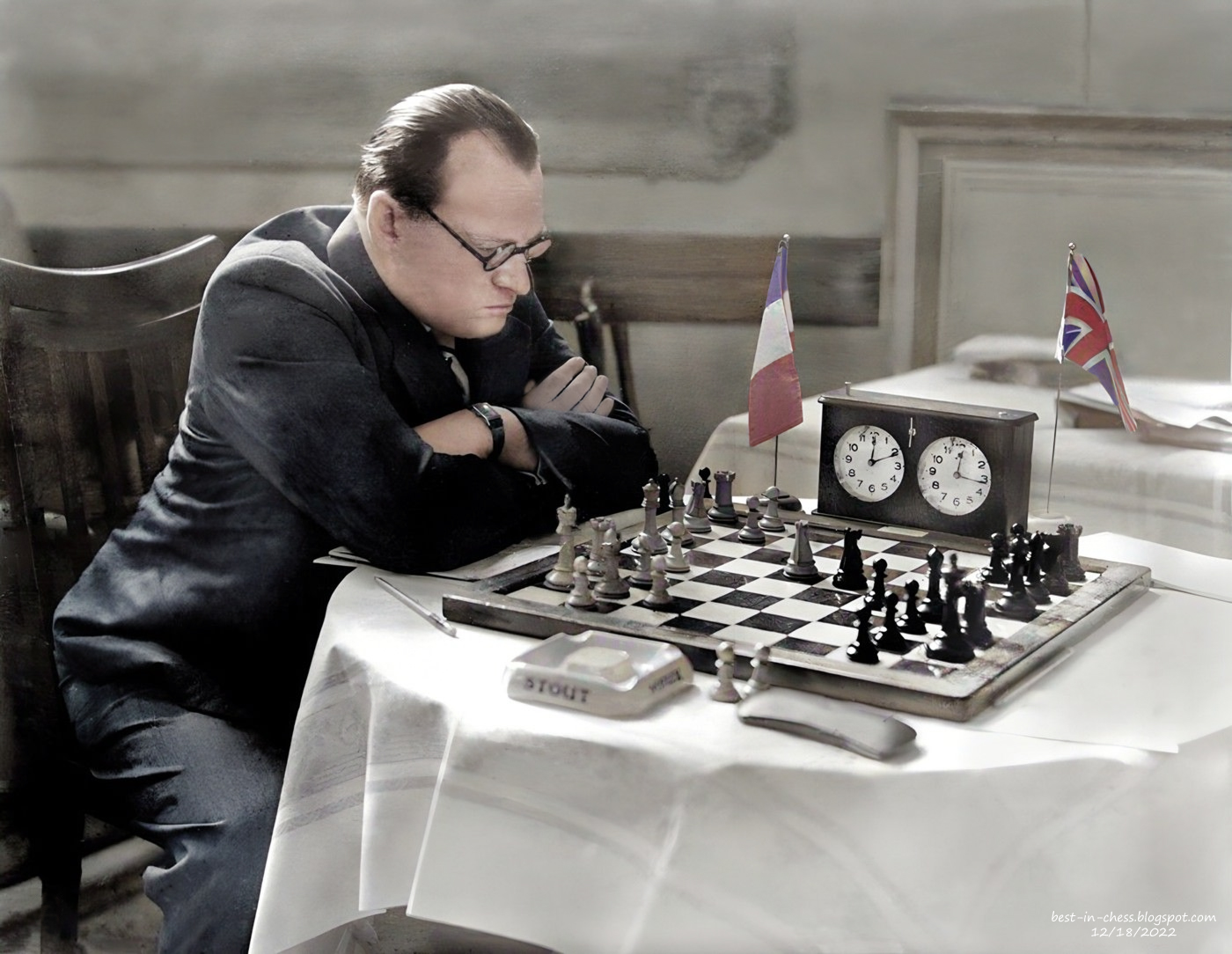
In the opulent drawing rooms of pre-revolutionary Moscow, where aristocratic families hosted lavish soirées amid the fading glow of the Russian Empire, a privileged boy with piercing eyes discovered chess at the tender age of six or seven. Alexander Alexandrovich Alekhine, born on October 31, 1892, into a wealthy noble family, would grow into one of the most dynamic and controversial figures in chess history. The fourth official World Champion, he held the title in two reigns: from 1927 to 1935, and again from 1937 until his death in 1946—the only champion to pass away while still possessing the crown. Alekhine was a whirlwind of imagination and aggression. Unlike Capablanca’s effortless precision or Lasker’s psychological depth, Alekhine thrived on complexity, deep calculation, and daring sacrifices. He combined fierce attacking play with meticulous preparation, turning chess into a battlefield of ideas where he hunted kings with relentless energy. His games crackled with tactical fireworks and profound strategic vision. Yet his life was as turbulent as his style: survival through revolution and war, exile, brilliant triumphs, a shocking loss and comeback, wartime controversies, and a lonely end in a Portuguese hotel. Alekhine didn’t just play chess—he waged war on the board, leaving a legacy of immortal combinations that still inspire players today.
Alekhine’s early years were comfortable. His family owned estates and indulged his passion for chess. By his teens, he was already a force. In 1909, at seventeen, he won the All-Russian Amateur Tournament in St. Petersburg with a commanding performance. He earned the master title and quickly climbed the ranks. The landmark 1914 St. Petersburg tournament, one of the strongest ever assembled, featured World Champion Emanuel Lasker, the rising José Raúl Capablanca, and other giants. Alekhine finished third behind Lasker and Capablanca, but his play announced his arrival among the elite. That same year, he tied for first in the All-Russian Championship and shared first in Paris. World War I interrupted his ascent. While playing in Mannheim, Germany, he was interned as an enemy alien but was later released. He returned to Russia, served in the Red Cross (and reportedly as a police detective and even a film extra during chaotic times), and survived the 1917 Russian Revolution and subsequent Civil War.
In the turbulent post-revolutionary years, Alekhine adapted. In 1920, he won the first USSR Championship with a dominant score (nine wins, six draws, no losses) and swept the Moscow Championship 11-0. Despite his noble background—which once earned him a death sentence commuted thanks to his chess achievements—he secured permission to leave Soviet Russia in 1921 with his first wife (they soon separated). He settled in France, becoming a naturalized French citizen in 1925 and representing France thereafter. He studied law at the University of Paris, though chess remained his true vocation. Free from Soviet constraints, Alekhine launched a relentless campaign to challenge Capablanca, the seemingly invincible champion.
The 1920s saw Alekhine dominate tournaments while preparing for the ultimate test. He won or shared first at major events like Baden-Baden 1925, Semmering 1926, and others, establishing himself as the clear challenger. He studied Capablanca’s games obsessively, noting vulnerabilities in even the Cuban’s seemingly flawless technique. The 1927 World Championship match in Buenos Aires was a marathon: 34 games over nearly three months. Capablanca entered as the heavy favorite; he had never lost to Alekhine in a serious game before. Alekhine shocked the world. He played into Capablanca’s strengths—simple positions and endgames—yet outprepared him in openings, defended cramped positions brilliantly, and launched counterattacks with precision. Alekhine won six games to Capablanca’s three, with 25 draws. On November 29, 1927, the “invincible” Capablanca fell. Alekhine became the fourth World Champion at age 35. The chess world reeled; an era of elegance gave way to one of dynamic aggression.

As champion, Alekhine continued his tournament supremacy. He won strong events across Europe and avoided a rematch with Capablanca, citing various reasons including financial conditions. In 1929 and 1934, he defended his title successfully against Efim Bogoljubow in matches that were largely one-sided (1929: +11 -5 =9; 1934: +8 -3 =15). Alekhine also set records in blindfold chess, playing up to 32 games simultaneously in exhibitions that showcased his extraordinary memory and visualization.

Yet complacency and personal issues crept in. By 1935, Alekhine faced a surprising challenger: Max Euwe, the Dutch mathematician and amateur champion. The 1935 match in the Netherlands was close and dramatic. After 14 games it was even; Euwe then surged ahead, winning four of the next stretch. Alekhine fought back but ultimately lost 15.5–14.5. For the first time since 1921, he was no longer champion. Many attributed the loss to overconfidence, heavy drinking, and underestimating Euwe’s solid preparation.
Alekhine responded with characteristic ferocity. He trained rigorously, reduced his drinking, and demanded a rematch. In 1937, again in the Netherlands, he regained the title decisively: 15.5–9.5 (+10 -4 =11). At 45, he proved he remained the world’s strongest player when motivated. He held the crown for the rest of his life.
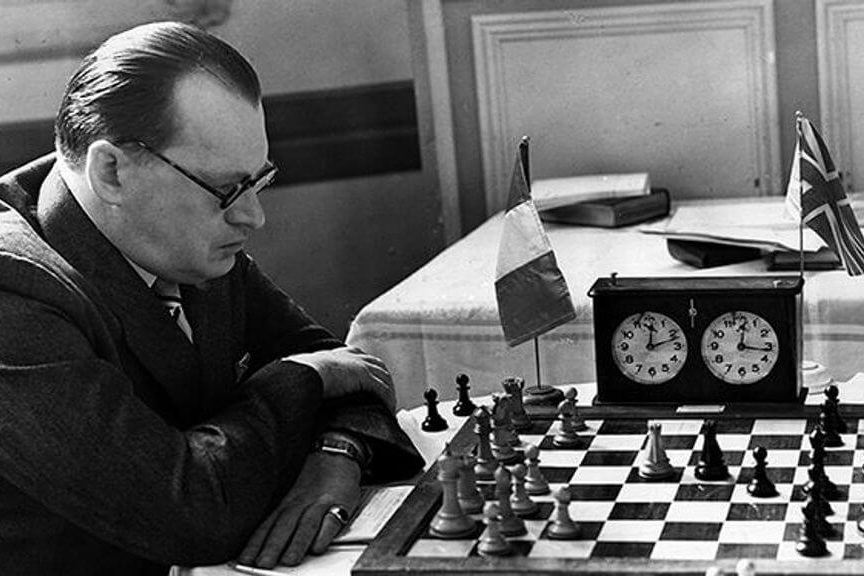
The late 1930s brought mixed results. Alekhine won the 1938 AVRO tournament in the Netherlands (a key qualifier for future challengers), defeating Capablanca in one memorable game—the first time he had ever beaten the Cuban in a tournament setting. But World War II upended everything. At the 1939 Buenos Aires Olympiad, Alekhine played board one for France and delivered an outstanding performance (12.5/16), helping his team. When war broke out, he returned to Europe, served briefly in the French army, and was demobilized after France’s fall.
The wartime years remain the most controversial chapter of Alekhine’s life. Living under Nazi occupation in France (and later moving to Portugal), he participated in several tournaments organized in Germany and occupied territories (Munich, Salzburg, Warsaw, Prague). In 1941, a series of articles titled “Aryan and Jewish Chess” appeared under his name in the Pariser Zeitung and other publications. These pieces applied Nazi racial ideology to chess, contrasting an alleged “aggressive Aryan” style with a “cowardly Jewish” one, and disparaged Jewish players like Steinitz and Lasker. After the war, Alekhine vehemently denied full authorship, claiming the articles had been altered or written under duress by Nazi authorities. Historians debate the extent of his collaboration versus coercion; he was never formally charged, and he expressed regret in interviews. The episode stained his reputation but did not erase his chess achievements.
Despite the war, Alekhine continued playing when possible and maintained high-level form. In 1946, as the war ended, negotiations advanced for a world championship match against the rising Soviet star Mikhail Botvinnik. Arrangements were nearly complete when tragedy struck. On the morning of March 24, 1946, in his room at the Park Hotel in Estoril, Portugal, Alekhine was found dead at age 53. The official cause was asphyxiation from a piece of meat lodged in his throat while eating (choking), though theories of heart attack, stroke, or even foul play have circulated without conclusive evidence. He died undefeated as champion—the only one in history to do so. His body was later moved to Paris and buried in the Montparnasse Cemetery.
Alekhine’s chess contributions were monumental. He authored classic books like My Best Games of Chess 1908–1923 and 1924–1937, which remain essential reading for their deep annotations and insight. He popularized complex, hypermodern ideas while excelling in direct attacks. His combinations—such as the famous queen sacrifice against Bogoljubow or deep maneuvers against Capablanca—demonstrate extraordinary imagination. He scored over 73% in more than 1,000 tournament games and played in five world championship matches, winning four. Garry Kasparov and others rank him among the all-time greats for his universal style and fighting spirit.
Beyond the board, Alekhine was a complex man: multilingual, cultured, but plagued by personal demons including alcoholism. His life spanned empires’ collapse, revolution, two world wars, and the dawn of the Soviet chess machine. From Moscow aristocrat to French citizen, from revolutionary survivor to wartime figure, Alekhine embodied resilience and brilliance amid chaos.
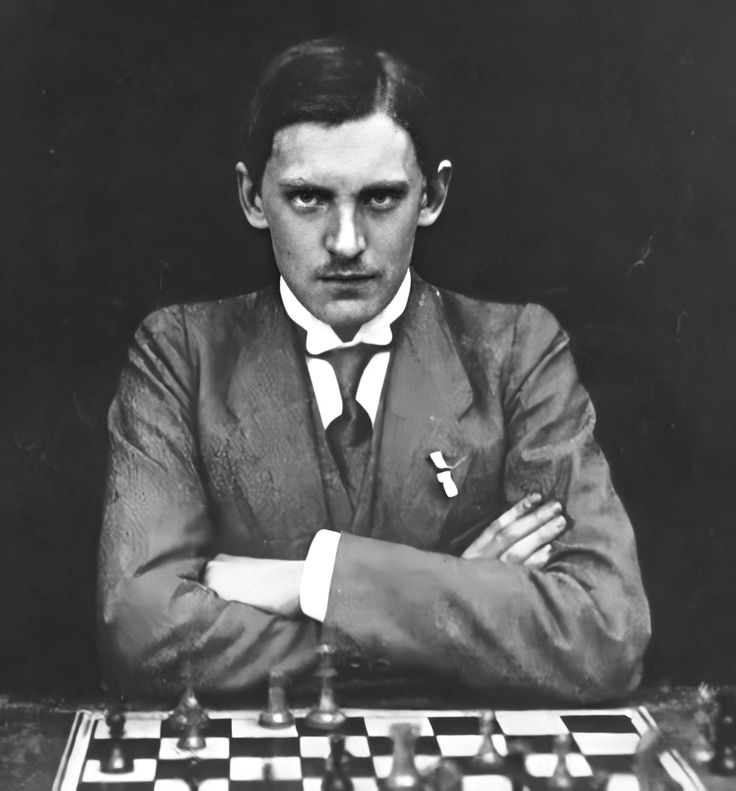
Today, when players study Alekhine’s immortal games or debate his wartime actions, one truth stands clear: he transformed chess into a more dynamic, combative art. His aggressive vision and tactical genius expanded the game’s boundaries. The only champion to die holding the title, Alexander Alekhine left the chess world richer—and forever unsettled—by his ferocious legacy.